
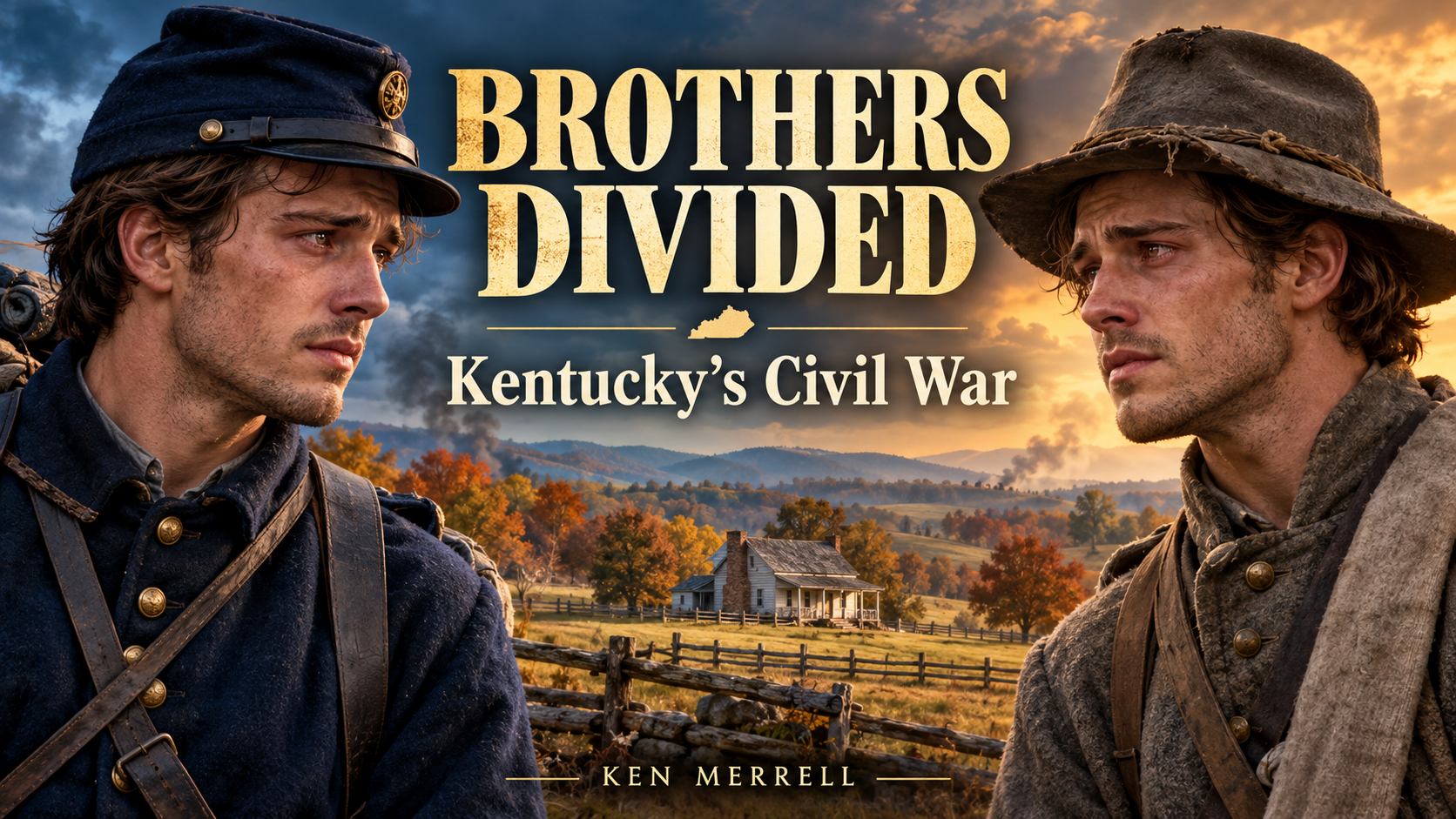
How brothers raised beneath the same roof found themselves fighting for opposing armies—and why some had less choice than we might imagine.
Imagine being a father with two sons.
You raised them in the same home. Taught them the same values. Watched them grow into men.
Then a war comes, and one son puts on a blue uniform while the other chooses gray.
And you know that somewhere, on some distant battlefield, your sons might find themselves facing one another.
That was not merely a novelist’s invention. It happened in Kentucky during the American Civil War.
And perhaps no family illustrated the tragedy more clearly than the Crittendens.
A Father Who Tried to Prevent the War
John J. Crittenden was one of Kentucky’s most respected political leaders. He had served as governor, United States senator, and attorney general.
As the country moved toward civil war, Crittenden desperately sought a compromise that might preserve the Union. In December 1860, he proposed constitutional amendments intended to settle the sectional dispute over slavery.
His proposal failed.
And the tragedy that followed reached directly into his own household.
His son Thomas Leonidas Crittenden became a general in the Union Army.
Another son, George Bibb Crittenden, became a general in the Confederate Army.
Two brothers. Two armies. One father who had tried to keep the nation from tearing itself apart.
But the Crittendens were hardly alone.
Throughout Kentucky, families faced decisions that would divide them for generations.
A State Caught Between Two Worlds
Kentucky occupied a particularly difficult position in 1861.
It was a slaveholding state with deep economic, cultural, and family ties to the South. Yet many Kentuckians cherished the United States and believed secession threatened the country their fathers had helped build.
Some believed their first duty was to preserve the Union. Others believed the Southern states had the right to leave it. Many white Kentuckians opposed secession while also opposing abolition.
And some wanted nothing more than to be left alone.
When fighting began in April 1861, Kentucky attempted to remain neutral.
On May 16, its legislature adopted a resolution declaring neutrality. The hope was that Kentucky could avoid becoming a battlefield and perhaps help bring the opposing sides back together.
But neutrality proved impossible.
Both armies recognized Kentucky’s strategic importance. Its rivers, railroads, roads, and location made it a gateway between North and South.
By September 1861, Confederate troops had occupied Columbus in western Kentucky, and Union forces had moved into Paducah. Kentucky’s legislature committed the state to the Union.
Yet the government’s decision did not settle the convictions of every household.
Kentucky remained a state whose people were deeply divided.
When the Armies Came Recruiting
For many Kentucky families, choosing sides was not always as simple as deciding which cause they believed in.
Sometimes the war came directly to their doorstep.
When Union forces controlled an area, recruiting officers sought men to fill their regiments. When Confederate armies moved through Kentucky, they also attempted to enlist local men.
A young farmer might hear a Union recruiting officer appeal to his patriotism one month and watch Confederate cavalry ride through his community the next.
Both armies wanted Kentucky’s manpower.
Union recruiting camps were established in Kentucky and across the Ohio River. Confederate recruiting camps operated just beyond the state’s southern border.
As military campaigns moved back and forth, so did opportunities—and pressures—to enlist.
Confederate General John Hunt Morgan’s raids into Kentucky in 1862 were intended partly to encourage men to join the Southern cause. But Confederate commanders often discovered that Southern sympathy did not necessarily translate into a willingness to leave home and become a soldier.
Some men volunteered enthusiastically.
Others hesitated.
They had farms to tend, crops to harvest, livestock to feed, and families depending on them.
And the longer the war continued, the more difficult remaining outside it became.
The Confederacy enacted a national conscription law in 1862, although that law did not formally apply to Kentucky because the state had not joined the Confederacy.
The United States enacted a national draft in 1863, which did apply to Kentucky.
Military recruiting could therefore involve financial incentives, patriotic appeals, community pressure, and the possibility of compulsory service.
There is an important distinction here. Confederate forces recruited Kentuckians during raids and campaigns, but their national draft did not legally cover the state. Claims that individual Confederate soldiers forcibly conscripted Kentucky civilians require evidence of particular incidents.
Still, imagine the uncertainty facing a young man whose community changed hands during the war.
Would refusing to enlist make him appear disloyal?
Would joining one army endanger relatives sympathetic to the other?
What would happen to his family if he left?
A uniform might reveal which army a man served, but it did not always explain every pressure that had led him there.
And when brothers ended up fighting on opposite sides, their circumstances could be as different as their convictions.
The Question of Slavery
No honest account of Kentucky’s Civil War can overlook slavery.
The preservation and expansion of slavery lay at the heart of the sectional crisis that led to secession and war.
Kentucky’s position was particularly complicated because slavery remained legal there even after the state committed itself to the Union.
Many white Kentuckians wanted to preserve the United States without ending slavery.
When President Abraham Lincoln issued the Emancipation Proclamation, effective January 1, 1863, it did not apply to Kentucky because Kentucky was not considered a state in rebellion.
That created a painful contradiction.
Kentucky soldiers could fight to preserve the Union while slavery remained lawful in their own communities.
For enslaved Black Kentuckians, however, the war presented a different question.
Not simply which government should rule them, but whether they and their families could finally become free.
In 1864, the United States Army began recruiting Black soldiers in Kentucky on a large scale.
Camp Nelson, near Nicholasville, became one of the nation’s most important recruiting centers for United States Colored Troops.
Thousands of enslaved men made their way there, understanding that military service could provide a path to freedom.
By the end of the war, more than 23,000 African American men had enlisted in the Union Army in Kentucky.
Their courage transformed the meaning of the war within the state.
But freedom did not come easily to their families.
In November 1864, military authorities expelled hundreds of Black women and children seeking refuge at Camp Nelson. More than one hundred died following exposure to the bitter weather and resulting illness.
The tragedy helped spur federal action to protect and emancipate the families of Black soldiers.
Kentucky’s Civil War was therefore not merely a struggle between white families divided by loyalty. It was also a struggle in which enslaved people fought for freedom while the society around them resisted profound change.
When the War Followed Them Home
For ordinary Kentucky families, the fighting was never confined to distant battlefields.
Military campaigns, cavalry raids, guerrilla warfare, and political suspicion brought the conflict into towns, farms, and neighborhoods.
An army passing through could demand food, horses, wagons, or labor.
A family’s political reputation could determine how soldiers treated them.
A farmer might have one son in the Union Army and another serving the Confederacy.
A wife might fear that her husband’s sympathies would bring trouble upon their household.
Neighbors who had once helped each other harvest crops could find themselves on opposite sides of an increasingly bitter conflict.
Letters from the front became precious, but they could also bring terrible news.
And even when there was no battle nearby, families lived with questions that had no comforting answers.
Would their sons come home?
Would they recognize the men who returned?
Would the family still be a family when the war was over?
The Battle That Changed Kentucky
In October 1862, Confederate General Braxton Bragg’s invasion of Kentucky culminated in the Battle of Perryville.
It was the largest Civil War battle fought in the state.
Thousands of men were killed, wounded, or reported missing.
Although the fighting did not produce a clear tactical victory, Confederate forces ultimately withdrew, and Kentucky remained under Union control for the rest of the war.
But the withdrawal of the main Confederate army did not end Kentucky’s suffering.
Raids and irregular warfare continued.
Families remained divided.
And political disagreements grew even sharper as the Union increasingly made emancipation a central war aim.
By the war’s end, approximately 100,000 Kentuckians had served in Union forces, while estimates suggest another 30,000 to 40,000 served the Confederacy.
Those numbers represented more than military strength.
They represented households emptied of fathers and sons.
And sometimes they represented brothers who had gone to war against one another.
When the Shooting Stopped
In 1865, the Confederacy collapsed.
The Union had survived.
But victory did not mean that every Kentucky family could simply return to the way things had been.
Some soldiers returned to communities where their neighbors considered them traitors.
Others returned to discover that the political and social order they had known was changing.
Kentucky did not abolish slavery during the war. Enslaved people in the state gained constitutional freedom when the Thirteenth Amendment became effective in December 1865.
The state also developed a complicated memory of the conflict.
Although Kentucky had remained in the Union, Confederate sympathies became influential in portions of its postwar culture and politics.
Families had to find ways to live together again, even when they remembered the war very differently.
Some reconciled.
Others never did.
The Hardest Part of a Civil War
There is something especially heartbreaking about a war fought between people who know one another.
An enemy across an ocean can seem distant.
But what happens when the man wearing the other uniform once slept in the bedroom beside yours?
What happens when you both remember the same Christmas mornings, the same family prayers, and the same father’s voice calling you home?
What if one brother volunteered because he believed he was defending his country, while another joined the opposing army because he believed he was defending his home?
And what if a third wanted no part of the war at all, but found himself caught between armies that demanded his loyalty?
The story of Kentucky reminds us that civil war is not simply the division of a nation.
It is the division of communities, churches, friendships, and families.
The Crittenden brothers became generals in opposing armies while their father had spent his final political years trying to prevent the conflict.
Thousands of less-famous Kentuckians experienced their own versions of that tragedy.
Their names may never appear in history books.
But their choices, sacrifices, and losses were no less real.
Perhaps that is the deepest tragedy of civil war: the people who survive must somehow find a way to live together again.
And sometimes the deepest wounds are those that remain long after the shooting stops.
Kentucky’s Divided Families: When the Civil War Came Home
By Ken Merrell••10 min read•6 readers
Direct Answers & Research
Frequently Asked Questions

MORE DISPATCHES & ARTICLES



Reflections & Discussion
No comments yet.
Be the first to share your thoughts, historical theories, or reactions with Ken!
Leave a Thought or Question
Your email address will not be published. Required fields are marked *