
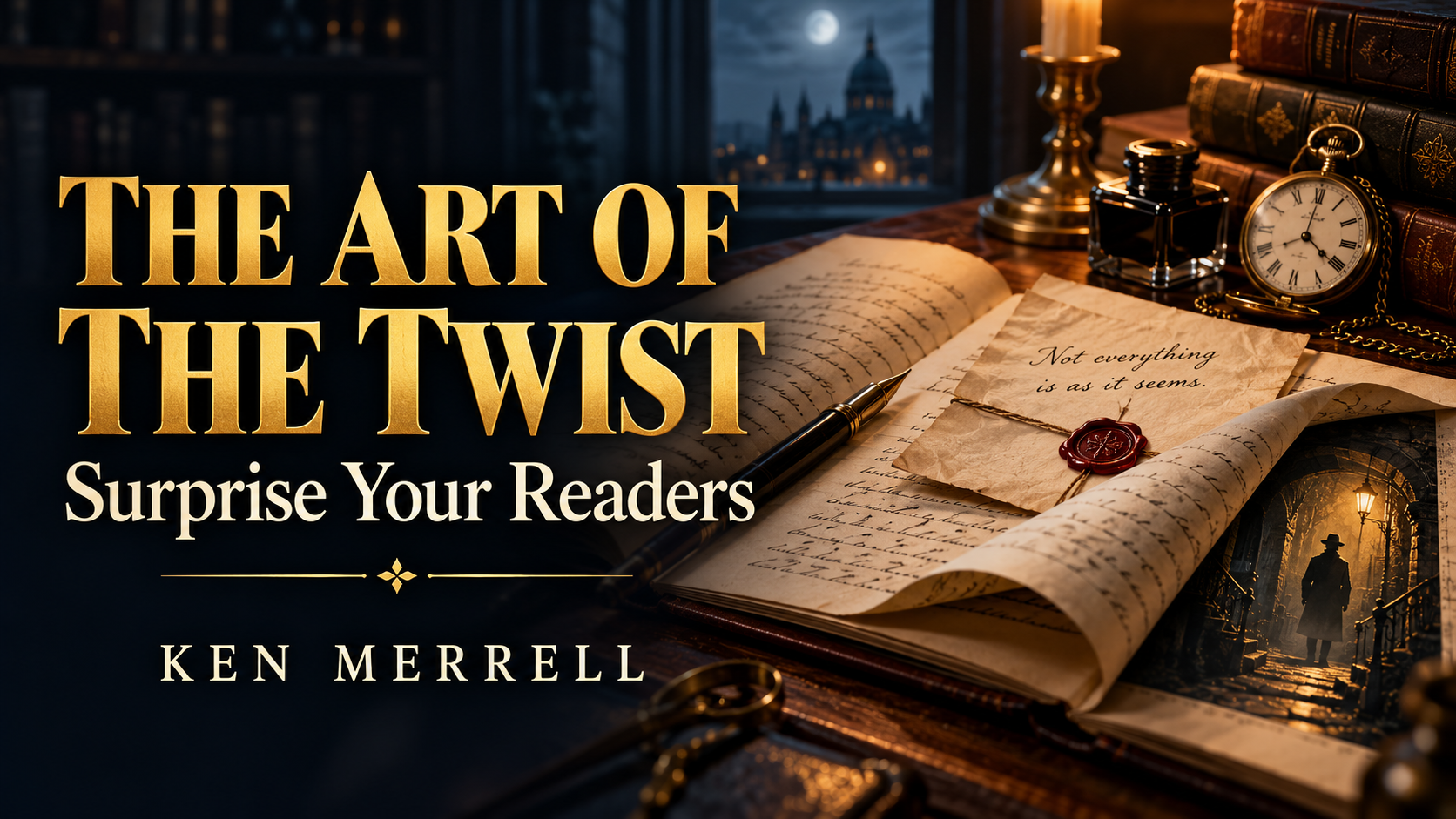
The Moment Every Storyteller Wants
There is a moment every storyteller dreams of creating. A reader reaches the end of a chapter, stops, and says, “Wait a minute. I never saw that coming.” Then something even better happens: the reader turns back a few pages and realizes the clues were there all along.
That is the magic of a well-crafted twist. It is not simply an unexpected event. It is a revelation that changes the reader’s understanding of the story. Learning to create those moments is one of the most rewarding—and difficult—parts of writing fiction.
The Difference Between a Surprise and a Twist
Imagine a detective investigating a murder. He spends two hundred pages gathering evidence, questioning suspects, and following clues. Then, in the final chapter, a stranger walks through the door and confesses. Surprising? Perhaps. Satisfying? Probably not. The reader has never met this person, and nothing prepared us for the revelation.
Now imagine the detective discovers that the murderer’s identity was revealed in the first chapter—but in a way neither he nor the reader understood. An innocent conversation takes on a sinister meaning. An overlooked detail becomes important. A character’s unusual behavior finally makes sense. That is a twist.
A surprise changes what happens next. A great twist changes what we believe happened before. Readers want to be surprised, but they also want to believe the author played fairly.
Never Underestimate the Reader
I believe every writer should begin with one fundamental assumption: the person reading your story is every bit as intelligent as you are. Perhaps more so.
That reader is paying attention. They are watching your characters, remembering conversations, noticing inconsistencies, and drawing conclusions. They deserve your respect.
A writer should never assume that readers can be fooled simply because the author controls the story. Certainly, we can surprise them. We can lead them toward conclusions that turn out to be wrong. But we must never cheat them.
Characters can lie. Characters can deceive one another. Characters can misunderstand what they have seen or heard. But a trustworthy narrator must never deliberately deceive the reader.
Suppose a man tells the detective, “I was home all evening.” The detective believes him. The reader may believe him, too. Later, when we discover the man was lying, the revelation is perfectly fair. The character deceived both the detective and the reader.
But suppose an objective narrator tells us as fact that the man spent the entire evening at home. Two hundred pages later, we discover he was committing the murder. Unless the story has clearly established an unreliable narrator, the author has broken a promise. The reader was not outsmarted. The reader was lied to. That is not clever storytelling. It is cheating.
The Writer Knows More, but Must Play Fair
As writers, we possess one enormous advantage: we know what is going to happen. We know who committed the crime, who is hiding the secret, and what the final revelation will be. The reader does not. Our challenge is to use that advantage fairly.
We can choose which events to show. We can decide when a character learns something. We can allow misunderstandings to develop naturally. We can introduce clues that seem unimportant until much later. But we cannot present a falsehood as objective fact simply to preserve our surprise ending.
Consider a woman who discovers a bloodstained shirt in her husband’s closet. She concludes he is involved in a murder. We might describe her trembling hands as she realizes he must be the killer. That is fair: we are experiencing her conclusion. What if the shirt belongs to someone her husband was trying to save? The woman was mistaken. The reader may have been mistaken. Yet the author never lied.
Don’t Hide What a Character Would Naturally Know
There is another way writers sometimes cheat. They place the reader inside a character’s thoughts while deliberately concealing something that character already knows.
Imagine we follow a detective through an entire investigation. We hear his private thoughts and see the evidence through his eyes. Then, in the final chapter, he announces he identified the murderer a hundred pages earlier. He simply never thought about it while we were inside his head. If the narrative promised access to his reasoning, withholding that central conclusion solely to manufacture a twist violates the promise.
There are honest alternatives. Shift the viewpoint to another character. Show the detective’s actions without revealing his private reasoning. Or allow him to suspect the truth without enough evidence to prove it. Establish the rules of your storytelling, and honor them.
Let the Reader Beat You to the Ending
Writers sometimes become so determined to surprise their readers that they fear anyone guessing the ending. But if a reader figures out the twist before the final chapter, that does not necessarily mean the author failed. Sometimes it means the author succeeded. The clues were there. The reader paid attention. And they solved the puzzle.
I would much rather have an intelligent reader solve my mystery early than have every reader reach the ending and say, “There was no possible way I could have known that.” A twist should not depend upon information the author arbitrarily withheld. It should depend upon information the reader had an opportunity to understand.
Tell the Truth, but Not the Whole Truth
You do not necessarily have to hide information from readers. Sometimes you give them the truth in a way that invites an incorrect conclusion.
Consider a man standing outside a house late at night. He watches a light come on in an upstairs bedroom, waits until it goes out, and quietly approaches the back door. Readers may assume he is a burglar or stalker. But suppose he is a father who has finally found the house where he believes his missing daughter is being held. Every detail was true. The reader supplied the interpretation.
You give readers the truth, allow the characters to misunderstand it, and trust your readers to draw their own conclusions.
Give the Reader a Reason to Believe the Wrong Thing
Misdirection works best when it grows naturally from the story. A woman refuses to answer questions about her past. We assume she is hiding something terrible. She is—but perhaps she is concealing a sacrifice she made to protect someone else. Her secrecy is real, her fear is real, and her reluctance to speak is real. Only our interpretation is wrong.
This kind of twist transforms a character. Someone we distrusted becomes someone we admire. Or someone we trusted becomes someone we suddenly fear. The revelation changes not merely the plot, but our emotional relationship with the people in it.
Plant the Clues Before You Need Them
A great twist must be prepared long before it happens. Decide what readers will eventually discover, then work backward and determine what evidence should already be visible.
Suppose a man claims he has never visited a certain town. Early in the book, he casually mentions the old railroad station’s green roof. Nobody notices. A hundred pages later, the detective discovers the station was demolished twenty years earlier. How could the man know about it?
The clue was present, surrounded by information that seemed more important. Do not put a spotlight on every clue. Let some pass through ordinary conversation, a room description, or a seemingly unimportant decision.
Hide a Clue Beside Something More Interesting
Imagine a woman entering her father’s study after his death. She finds an unopened letter, an old photograph, and a pocket watch stopped at 3:17. The letter attracts attention. So does the photograph. The watch seems like atmosphere.
Later we discover that someone deliberately stopped the watch to record a significant moment. The clue was visible. We encouraged readers to look elsewhere. This works because people naturally prioritize information—but the detail must belong in the scene, not look like a collection of planted tricks.
A Twist Should Grow From Character
Some twists are mechanical: a hidden door, a secret document, an unexpected identity. Those can entertain. But the twists readers remember longest reveal loyalty, love, fear, betrayal, sacrifice, or forgiveness.
Consider brothers estranged for twenty years because one supposedly stole their father’s inheritance. At the end, we learn he did take the money—but used it to save the other brother’s child, accepting the blame to protect a painful family secret. Every harsh word and lost Christmas now means something different. The twist is not simply where the money went. It is the cost of a sacrifice nobody understood.
Sometimes the Greatest Twist Is Kindness
We associate twists with mysteries and thrillers, but emotional revelations can be just as powerful. In O. Henry’s The Gift of the Magi, a husband sells his watch to buy combs for his wife’s hair, while she sells her hair to buy a chain for his watch. Neither gift can be used as intended, yet the ending reveals how much each was willing to sacrifice.
In O. Henry’s The Last Leaf, a sick young woman believes she will die when the final ivy leaf falls. One leaf remains after a storm and restores her will to live. Later we learn an elderly artist painted that leaf in the storm and died after the exposure. What looked like a leaf becomes an act of love. The emotional revelation is enough.
The Danger of Twisting Too Often
Once writers discover how satisfying a twist can be, they may try one in every chapter. The missing child is the detective’s daughter. The detective is the villain. The villain is an impostor. Eventually, the reader stops believing anything.
A story needs solid ground. Readers must be able to trust some of what they experience, even when individual characters are unreliable. When everything is a trick, nothing is surprising.
Three Questions for Every Twist
First: Will the reader be surprised? If not, perhaps the clue is too obvious or the revelation too weak.
Second: Will the reader believe it? The revelation must fit the established facts. Readers forgive being misled by characters; they resent being cheated by the author.
Third: Will the reader care? A clever revelation means little unless it changes the stakes, relationships, or meaning. The strongest twists make us feel fear, grief, relief, regret, or tenderness.
Write the Ending Before You Hide the Beginning
One practical method is to work backward. Decide the final revelation, then ask what readers must believe just before it. What evidence would make that belief reasonable? What truthful clues could you plant earlier?
Not every detail must be outlined before writing. Sometimes a twist emerges while developing characters. But once discovered, return to earlier chapters and prepare for it. A twist written at the end may require careful revision at the beginning. That is part of the craft.
The Final Test of a Fair Twist
Imagine readers returning to the beginning after learning the ending. Will they find the clues? Will conversations still make sense? Will actions remain consistent? Most importantly, will they discover you told them the truth—not necessarily the entire truth, or in the order they expected, but the truth?
The finest compliment is not simply, “You fooled me.” It is: “I should have seen it coming. You gave me everything I needed.” A cheap trick abuses trust. A great twist rewards it.
The Story Beneath the Story
After years of writing, I have come to believe the greatest twists are not always the most complicated. Sometimes the person we feared was trying to protect someone. The person we despised had made an extraordinary sacrifice. Or the seemingly insignificant person was responsible for everything good that happened.
Those revelations remind us how easily we misunderstand people. We see actions without knowing reasons and judge decisions without understanding circumstances. Sometimes learning the truth changes everything.
The finest twist does not merely make us turn back a few pages. It makes us see the entire story—and perhaps the people around us—in a different light.
I’m Ken Merrell, and that’s a story worth sharing.
The Art of the Twist: How Great Storytellers Surprise Their Readers
By Ken Merrell••11 min read•4 readers
Direct Answers & Research
Frequently Asked Questions

MORE DISPATCHES & ARTICLES

Reflections & Discussion
No comments yet.
Be the first to share your thoughts, historical theories, or reactions with Ken!
Leave a Thought or Question
Your email address will not be published. Required fields are marked *