
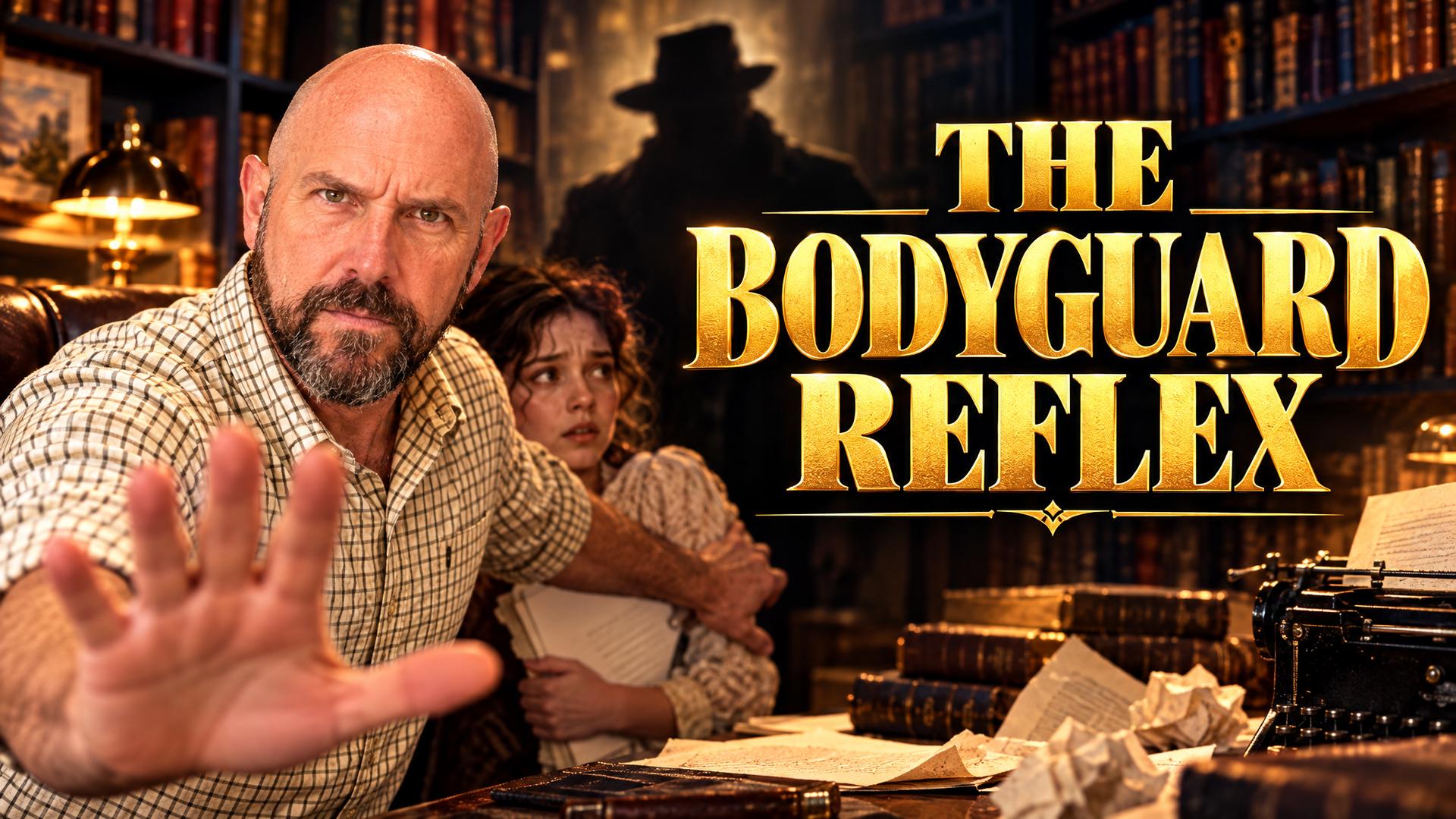
There's someone standing just outside the pages of your novel.
You won't find him in the cast of characters. He doesn't appear in the dialogue. He never enters a room or speaks a word.
But he's there. Watching. Waiting.
And whenever one of your favorite characters gets into serious trouble, he steps forward and makes certain nothing too terrible happens.
He's the bodyguard.
And there's a good chance you've hired him without even realizing it.
I call this The Bodyguard Reflex.
It's the instinct writers develop to protect the people they've created, particularly those they've come to love. And it can destroy an otherwise excellent novel.
Because real life doesn't provide us with a bodyguard who steps in whenever our decisions threaten to ruin our lives. Neither should fiction.
Before we're finished, I want to explain how this reflex develops, why readers recognize it even when writers don't, and how to remove it without turning your novel into a slaughterhouse.
And there's one principle beneath everything we're going to discuss:
Every action has consequences. Every inaction has consequences. And every character must remain true to who they are.
- Why Writers Hire the Bodyguard
When I begin writing a novel, my characters are strangers. I may understand their circumstances and have some idea where their lives are headed, but I don't know them completely.
That changes as I write. I discover their fears, their loyalties, their weaknesses, and their ambitions. I learn what embarrasses them, what angers them, and what they would sacrifice to protect someone they love.
Eventually, some become almost like old friends. And that's where the trouble begins.
Because when we love someone, we want to protect them.
A writer can spend months developing a character, giving that person a history, a family, a personality, and a future. Then the story reaches a moment when that character's choices should produce a terrible consequence.
Perhaps death. Perhaps disgrace. Perhaps the loss of everything the character has worked to achieve.
And suddenly, the writer hesitates. Surely there's another way.
So we invent one. A rescue arrives at precisely the right moment. An enemy makes an inexplicable mistake. A character suddenly discovers an ability we've never established. Or someone behaves in a way completely inconsistent with the person we've spent the entire novel developing.
The character survives. The writer feels relieved. But the story has suffered.
Because we didn't solve the problem honestly. We sent in the bodyguard.
- Plot Armor Is the Symptom. The Bodyguard Is the Cause.
You may have heard the expression plot armor.
It's a familiar term in discussions of movies, television, games, and fiction. It describes the apparent immunity certain characters enjoy because the story needs them to survive.
But I want to distinguish plot armor from something happening inside the writer.
Plot armor is what the reader sees.
The Bodyguard Reflex is what the writer does.
It's the moment we recognize that a character's decisions should lead to a painful consequence, but we begin searching for a way to protect that character from it.
And sometimes we do this so subtly that we don't recognize the interference ourselves. We convince ourselves that the rescue is believable. We tell ourselves the character deserves another chance.
We decide the story would be too depressing if something terrible happened.
But those aren't necessarily storytelling decisions. Sometimes they're emotional decisions made by an author who has become too attached to a fictional person.
And the reader eventually notices.
- Real Life Doesn't Provide a Bodyguard
Consider the world outside fiction.
A man neglects his marriage for twenty years. He may love his wife. He may be a good provider. He may believe that everything he's doing is for his family.
But neglect has consequences. One morning, his wife may decide she's finished waiting for him to become the husband she needed.
Now suppose the same situation occurs in a novel. The writer likes this man. He's hardworking, generous, and fundamentally decent.
So when his wife finally confronts him, he gives a beautiful speech about how much he loves her. She cries. They embrace. The marriage is saved.
Perhaps that ending could work. But has the writer earned it?
Has the husband actually changed? Has the wife been given a believable reason to trust him? Have twenty years of neglect somehow disappeared because he finally found the right words?
If so, we may be watching the bodyguard at work. The writer has protected the character from the consequences of his own behavior.
Now imagine a different ending. The husband finally understands what he's done. He apologizes sincerely. He promises to change. And his wife leaves anyway.
Not because she's cruel. Not because the writer wants a tragic ending. But because the damage is real, and understanding it doesn't automatically repair it.
That is a consequence. And it may create a far more powerful story.
- Inaction Is Still a Decision
One of the most overlooked principles of storytelling is that doing nothing can be just as consequential as doing something.
A father sees his son being bullied but refuses to intervene. A woman suspects her business partner is stealing but avoids confronting him. A soldier recognizes that his commanding officer has made a disastrous decision but remains silent.
In each situation, the character has made a choice. The choice is not to act. And that choice must carry consequences.
Sometimes the consequences are immediate. Sometimes they don't appear for years. But the absence of action doesn't erase responsibility.
In fact, some of the most powerful tragedies in literature occur because someone failed to act when action was still possible.
A writer who continually rescues characters from the consequences of their inaction is just as guilty of employing the bodyguard as one who saves them from the consequences of reckless behavior.
The story must remember what the character chose not to do.
- Characters Must Remain True to Who They Are
This may be the most important rule of all.
Every character develops an internal logic. That logic grows from personality, experience, beliefs, fears, loyalties, and desires.
A coward may become courageous. A selfish man may learn to sacrifice. A dishonest woman may finally tell the truth. But those changes must be earned.
They cannot happen simply because the writer needs a convenient solution.
Imagine a man who has spent an entire novel avoiding confrontation. He's frightened of violence. He hates conflict. He has repeatedly demonstrated that he will sacrifice almost anything to avoid danger.
Then, in the final chapter, he charges into a building filled with armed men and defeats them. Why? Because the author needed a hero.
Now, perhaps the man could become that hero. But the writer must establish the circumstances and inner transformation that make his courage believable.
Maybe someone he loves is trapped inside. Maybe he has spent the novel learning that cowardice has consequences. Maybe he is still terrified, but finally discovers something he fears losing more than his own life.
Now the decision belongs to the character. The writer hasn't simply forced him into heroism. The story has brought him there.
A character may change. But a character cannot become someone else merely because the author needs an escape route.
- Consequences Are Not Always Death
This is where I want to challenge the familiar advice to kill your darlings.
I believe writers must be willing to let beloved characters die when the story honestly demands it. But death is only one possible consequence. Sometimes it's not even the most painful.
A character might survive a battle but lose the trust of everyone who followed him. A mother might save her child but destroy her relationship with another child in the process. A businessman might preserve his fortune while losing the family he accumulated it for. A soldier might return home alive but discover that the person he was before the war no longer exists.
Those consequences may create more lasting emotional power than a death. And they open possibilities for further storytelling.
The important question isn't whether a character survives. It's whether the character's actions and circumstances have believable consequences.
You don't have to kill your characters to make danger real. You have to stop guaranteeing that they will escape its cost.
- The Difference Between Mercy and Manipulation
Writers are allowed to show mercy. People survive terrible accidents. Enemies sometimes make mistakes. Unexpected help occasionally arrives. Forgiveness is possible. Second chances are real.
The problem isn't mercy. The problem is unearned mercy.
Suppose a woman is trapped inside a burning building. At the last moment, a firefighter breaks through a window and carries her to safety.
Is that the bodyguard? Not necessarily.
If firefighters have been established at the scene, if the rescue is physically plausible, and if the danger remains believable, the outcome may be perfectly honest.
But suppose the building is isolated, nobody knows she's inside, and the fire has made escape impossible. Then, without explanation, a stranger appears and rescues her.
The writer has changed the circumstances to save the character. The reader recognizes the manipulation.
And the next time the character faces danger, the reader may be less worried. Because the writer has demonstrated that the rules can change whenever a favorite character needs help.
- The Reader Learns Whether Danger Is Real
Readers are remarkably good at recognizing patterns.
If every major character survives every crisis, they begin to expect survival. The writer may describe enormous danger. The villain may threaten terrible consequences. The hero may appear moments from death.
But the reader has already learned something the characters don't know. The author won't allow anything permanent to happen.
That's when suspense begins to disappear.
The characters are frightened. The reader isn't.
Now consider the opposite. Early in a novel, a capable, sympathetic character makes a believable mistake and suffers a serious, irreversible consequence.
The reader understands that the story's dangers are real. From that moment forward, every decision carries more weight. Even when characters survive, the reader knows survival wasn't guaranteed.
This doesn't mean we must kill someone in Chapter Three to prove we're serious. It means we must establish that the story honors its own rules.
- The Bodyguard Can Hide in Small Decisions
The most dangerous examples aren't always dramatic rescues. Sometimes the bodyguard appears in ordinary conversations.
A character says something deeply hurtful, but the other person forgives it immediately. A businessman makes a disastrous decision, but an unexpected opportunity restores his fortune. A child lies repeatedly, but the parents never lose trust. A soldier disobeys an order, but the consequences disappear because the writer wants him to remain admirable.
Individually, these moments may seem harmless. Together, they teach the reader that the characters are protected.
The writer has removed the cost of their behavior. And without cost, decisions lose meaning.
A character who risks nothing when making a choice isn't making a particularly interesting choice. The power of a decision often lies in what it may cost.
- When the Story Refuses Your Planned Ending
Sometimes the greatest challenge comes when the story you've written no longer supports the ending you intended.
You may have planned for two characters to marry. But after months of writing, their personalities, experiences, and choices have made that marriage unbelievable.
You may have planned for a character to survive. But the circumstances you've established offer no credible escape.
You may have planned for a villain to be redeemed. But the villain has committed acts that make a sudden transformation unconvincing.
Now you face a choice. Change the ending. Or change the story leading to it. Both are legitimate.
What isn't legitimate is pretending the contradiction doesn't exist.
You cannot simply order a character to behave differently because the ending requires it. That is the bodyguard taking control of the manuscript. And it usually leaves fingerprints.
- A Practical Test: Find Your Bodyguard
Take a completed chapter from your manuscript. Identify every important decision a character makes.
Then ask what that decision should reasonably cost. Not necessarily in money. Perhaps in trust, reputation, safety, opportunity, love, or peace of mind.
Next, identify the decisions the character avoided. What consequences should follow from those failures to act?
Then ask yourself something uncomfortable:
Did I protect this character because the story justified that protection, or because I didn't want anything bad to happen?
Look closely at coincidences. Look at sudden changes in personality. Look at enemies who become inexplicably incompetent. Look at relationships repaired by a single conversation after years of damage.
Look at characters who repeatedly escape consequences that would overwhelm anyone else in the same circumstances.
Those are places where the bodyguard may be hiding. And if you find him, don't immediately kill the character.
Instead, remove the artificial protection and reconsider what would honestly happen.
Sometimes the character will survive. Sometimes the character will change. Sometimes the character will lose something irreplaceable. And sometimes the story will take a direction you never anticipated.
That's part of the discovery of writing.
- The Final Test: Fire the Bodyguard
At the beginning of this article, I introduced someone standing just outside the pages of your novel. Someone watching your favorite characters. Someone ready to step forward whenever the consequences became too painful.
The bodyguard.
And I promised to show you how to remove him without turning your novel into a slaughterhouse. Now we can settle that promise.
You don't remove the bodyguard by becoming cruel. You don't remove him by killing characters randomly. You don't remove him by making every ending tragic.
You remove him by accepting three responsibilities.
First, every action must have consequences.
The consequences may be small or enormous, immediate or delayed, beneficial or destructive. But the story must acknowledge what the character has done.
Second, every inaction must have consequences.
Silence, hesitation, avoidance, and refusal are choices too. The world doesn't stop moving because a character refuses to act.
Third, every character must remain true to who they are.
Their decisions must grow from the people you've created, not from your desire to protect them or force the plot toward a predetermined conclusion.
And now comes the hardest part.
Sometimes you'll follow those principles and discover that a character you love cannot survive. Sometimes you'll discover that a relationship cannot be repaired. Sometimes the hero will fail. Sometimes the villain will escape punishment. And sometimes a good person will suffer despite doing everything right.
That's life. And fiction becomes more believable when we stop pretending otherwise.
But here's what makes removing the bodyguard worthwhile.
When your characters finally do survive, their survival means something. When forgiveness comes, it feels earned. When a frightened person discovers courage, the reader believes the transformation. When two people reconcile, we understand what they had to overcome.
And when a character makes the ultimate sacrifice, the loss carries the full weight of the life we've come to know.
You haven't made the story crueler. You've made its consequences honest.
There's a reason readers remember certain fictional people for decades. It isn't always because those characters succeeded. Often, it's because they faced circumstances that revealed who they truly were.
The writer allowed them to make their choices. And then allowed those choices to matter.
So the next time one of your favorite characters finds themselves in terrible trouble, resist the urge to rush in and save them.
Don't ask, How can I get this person out of here?
Ask, Given everything I've established about this character and these circumstances, what would honestly happen next?
Follow that answer wherever it leads.
You may discover that your character is more resourceful than you imagined. You may discover that the character's greatest victory requires an enormous sacrifice. Or you may discover that the ending you planned was never the ending the story deserved.
Whatever happens, let the consequences belong to the characters.
Because real life doesn't provide us with a bodyguard who protects us from every mistake, every failure, or every tragedy.
And as writers, we have no right to provide one for the people we've created.
You don't have to kill your characters.
You have to fire the bodyguard.
And once he's gone, something remarkable happens. Your characters are finally free to live—and sometimes die—according to the lives you've given them.
I'm Ken Merrell, and that's Wh This Story Works.


Reflections & Discussion
No comments yet.
Be the first to share your thoughts, historical theories, or reactions with Ken!
Leave a Thought or Question
Your email address will not be published. Required fields are marked *