
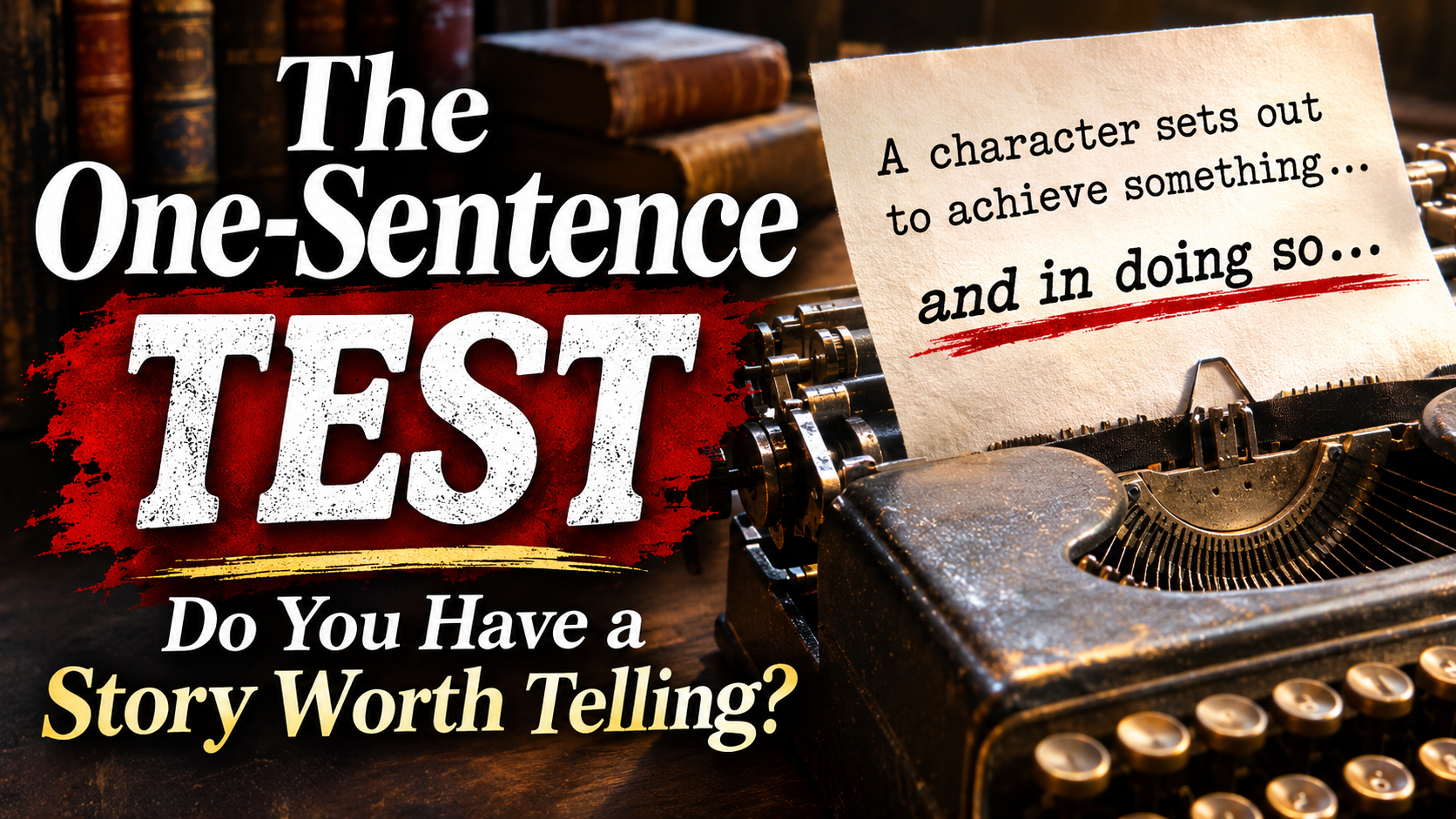
The One-Sentence Test: How to Know If You Have a Story Worth Telling
Eight Rules for Writing Stories Readers Don’t Just Read—They Experience
By Ken Merrell
Before you spend a year writing a hundred-thousand-word novel, see if you can tell me why that novel is worth writing in a single sentence.
The first test of a story is not whether it contains enough incidents. It is whether the incidents belong to one meaningful journey. A protagonist begins with a belief about what will make life better. Pursuing that belief changes the person—or reveals the cost of refusing to change.
There is also a second test, one I believe writers too often overlook: will readers merely observe that journey, or will they feel as though they are living it?
Contents
- Up: The Dream That Wasn’t the Destination
- A Christmas Carol: The Man Who Wanted to Be Left Alone
- Groundhog Day: The Man Who Wanted Tomorrow
- Les Misérables: The Man Who Wanted to Be Free
- Casablanca: The Man Who Wanted His Lost Love Back
- Dances with Wolves: The Soldier Who Wanted the Frontier
- The Count of Monte Cristo: The Man Who Wanted Revenge
- The Secret Garden: The Girl Who Wanted to Unlock a Door
- Moby-Dick: The Man Who Refused to Change
- The Difference Between Coincidence and Cause
- What These Stories Have in Common
- Why We Want to Be Hiccup
- The Eight Rules of a Meaningful Story
- How to Test Your Own Novel
- Why I Believe This Matters
- The Final Test
Introduction
Before you write the first chapter of your novel, I want you to try something. Tell me your entire story in one sentence. Not the setting. Not the backstory. Not the interesting characters you've invented or the surprising twists you've planned. Tell me who your main character is, what that character wants, and how the pursuit of that desire changes who they become.
And somewhere in that sentence, I want you to use four simple words: “And in doing so...”
Those words must connect two things that have a cause-and-effect relationship. The character doesn't simply pursue a goal and happen to change along the way. The pursuit itself must cause the transformation. If you cannot explain that connection, you may have an interesting premise, but you haven't yet discovered the heart of your story.
Spoiler warning: The following examples discuss major plot developments and endings.
- Up: The Dream That Wasn’t the Destination
A lonely widower sets out to fulfill the dream he shared with his deceased wife, and in doing so, discovers that honoring her memory means opening his heart to someone who needs him now, rather than clinging to the life he has lost.
Carl Fredricksen believes his happiness is somewhere in the past. His wife Ellie has died, and he clings desperately to their home and the dream of reaching Paradise Falls. But along the way, he encounters Russell, a young boy who needs a friend, and unexpected responsibilities that interfere with his carefully guarded dream.
Carl reaches Paradise Falls. Yet reaching the destination doesn't complete his journey. He discovers that the life he shared with Ellie was already their great adventure. He gives up the possessions he once refused to surrender to save Russell. The man who began by protecting everything from his past ends by sacrificing those things for someone else's future.
Carl’s original goal is essential because it gives his decisions a price. If he had never loved Ellie, the house would be only a strange means of transportation. Because we understand what it represents, letting it go becomes a profound choice. That is the difference between a clever premise and an emotionally complete story.
The original desire drives the plot. The transformation gives the plot meaning. And the two are inseparable.
- A Christmas Carol: The Man Who Wanted to Be Left Alone
A wealthy miser desperately wants to protect his money and remain free of other people's troubles, and in doing so, discovers through a terrifying journey into his own life that the isolation he has chosen will leave him with nothing worth living for.
Ebenezer Scrooge believes wealth is security. He protects himself from the obligations of loving other people. Three spirits force him to confront what he has lost, what others endure, and what will happen if he continues down the same path.
Scrooge doesn't lose his fortune. He changes what his fortune means. At the beginning, money is something to protect from others. At the end, it becomes something he can use to help others. A character hasn't truly changed simply because the author tells us they've learned something. They must make a choice they would never have made at the beginning.
- Groundhog Day: The Man Who Wanted Tomorrow
A selfish weatherman desperately tries to escape a day he is forced to live repeatedly, and in doing so, discovers that the way to escape his miserable existence is to stop living for himself and begin making life better for others.
Phil Connors wants tomorrow to arrive. He wants to escape Punxsutawney and return to the life he believes he deserves. First he manipulates circumstances. Then he indulges himself. Eventually he becomes desperate. Gradually he begins noticing other people, learning their needs, and helping them without expecting anything in return.
The external circumstances haven't changed. The day is still February 2. The world hasn't changed. Phil has. And only after that transformation does tomorrow finally arrive. The story isn't really about escaping a repeating day. It's about escaping a selfish life.
- Les Misérables: The Man Who Wanted to Be Free
A former convict sets out to build a respectable life and escape the shame of his past, and in doing so, discovers that true freedom comes not from protecting his new identity, but from sacrificing his own security to extend mercy to others.
Jean Valjean emerges from nineteen years of imprisonment into a world that refuses to forgive him. A bishop shows him extraordinary mercy. Valjean builds a respected new life, but his past pursues him through Inspector Javert. Again and again he must choose between protecting himself and helping others.
He saves an innocent man from being mistaken for him, rescues Cosette, and spares Javert. At the beginning Valjean wants freedom for himself. At the end he is willing to risk that freedom for others. His journey transforms him from a man seeking freedom into a man capable of giving it.
- Casablanca: The Man Who Wanted His Lost Love Back
A bitter nightclub owner hopes to reclaim the woman who once broke his heart, and in doing so, discovers that loving her means giving her up so she and her husband can continue fighting for something greater than either of them.
Rick Blaine insists he sticks his neck out for nobody. When Ilsa returns, his indifference collapses. For a time we believe winning her back is the ultimate goal. But Rick must decide whether love means possession or sacrifice.
He has the opportunity to keep Ilsa. Instead he arranges for her to leave with Victor Laszlo. The man who began refusing to sacrifice anything ends by sacrificing what he wants most. The original desire remains within reach. He chooses something greater.
- Dances with Wolves: The Soldier Who Wanted the Frontier
A disillusioned Civil War soldier seeks solitude and purpose on the American frontier, and in doing so, discovers a community and a way of life worth sacrificing his old identity to protect.
Lieutenant John Dunbar wants to see the frontier before it disappears. At first he observes the land and its people as an outsider. Gradually he forms relationships with a Lakota community, learns their language, and shares their experiences. His original goal was to experience the frontier, but the experience transforms his understanding of belonging. Eventually he must choose between his military identity and the people he has come to love. The destination is not the point. The transformation is.
- The Count of Monte Cristo: The Man Who Wanted Revenge
A young man falsely imprisoned sets out to punish everyone who destroyed his life, and in doing so, discovers that revenge can destroy innocent people as surely as injustice destroyed him, forcing him to choose mercy over vengeance.
Edmond Dantès escapes imprisonment, acquires a fortune, and reinvents himself as the Count of Monte Cristo. He becomes extraordinarily successful at revenge. But his schemes reach people who had nothing to do with his suffering. He questions whether he has assumed the right to dispense divine justice. The pursuit of revenge challenges the belief that justified it. Sometimes a character achieves what they wanted and discovers that it cannot give them what they need.
- The Secret Garden: The Girl Who Wanted to Unlock a Door
A lonely, disagreeable orphan sets out to discover the secret of a locked garden, and in doing so, finds that nurturing the neglected garden also teaches her to nurture friendships, heal a broken family, and transform her own unhappy life.
Mary Lennox arrives at a gloomy manor as a spoiled, emotionally neglected child. Her curiosity about a locked garden gives her something to pursue. As she restores the garden, she forms friendships and helps Colin emerge from isolation. The garden's restoration reflects the restoration within the characters. Mary doesn't simply discover the garden. In a sense, the garden helps her discover herself.
- Moby-Dick: The Man Who Refused to Change
A vengeful sea captain sets out to destroy the white whale that maimed him, and in doing so, allows his obsession to consume his judgment, his crew, and ultimately his own life.
Captain Ahab wants revenge. He turns his injury into consuming hatred, valuing the pursuit above his ship, crew, and survival. He receives warnings and has chances to reconsider, but refuses. His obsession destroys nearly everyone aboard the Pequod.
A tragic story can satisfy the same structural test. Ahab’s pursuit does not lead to wisdom; it reveals the devastating consequences of his inability to accept it. A writer should never mistake a happy ending for a necessary ending. What matters is that the conclusion grows out of the choices made along the way.
Ahab doesn't experience positive transformation. His refusal to change causes the tragedy. “And in doing so” still connects beginning to ending. A story can be about the price of refusing to change just as powerfully as the rewards of changing.
There is another possibility: a steadfast protagonist may hold to a conviction that is tested by the journey, and in doing so, transform the people or world around them. The test is still one of cause and effect. The pursuit must produce a meaningful consequence, even when the hero’s deepest belief remains intact.
- The Difference Between Coincidence and Cause
Consider this sentence: A lonely man travels across the country to find his brother, and in doing so, falls in love with a woman.
It describes two events, but not necessarily a story. Why does looking for his brother cause him to fall in love? What belief is challenged?
Now try this: A lonely man travels across the country to find the brother who abandoned him, and in doing so, discovers that the resentment he has carried for thirty years has prevented him from accepting the love and family already waiting for him at home.
Now the pursuit forces him to confront the belief governing his life. The difference is causation. In the first example two things happen. In the second, one thing happens because of the other. If the transformation could occur just as easily without pursuing the original goal, look for the missing link.
- What These Stories Have in Common
These stories span comedy, romance, adventure, fantasy, literary fiction, tragedy, and redemption. Each character begins with a desire. That desire drives a journey. The journey creates unexpected relationships, responsibilities, conflicts, or consequences. Those experiences challenge the original understanding of what matters—or expose the cost of refusing the challenge.
The wrong compass is not necessarily a bad compass. A desire can be honorable, even beautiful, and still be incomplete. The journey matters because it exposes the limits of the character’s first understanding of happiness, security, justice, or love.
I call this The Wrong Compass. The character starts toward something believed to bring happiness, security, love, justice, or fulfillment. The compass isn't necessarily foolish: Carl's desire to honor Ellie is admirable, Rick's wish to recover love understandable, Valjean's desire for freedom justified. But the journey reveals something the character could not see. The destination changes because the character changes—or, as with Ahab, refusal to change determines the ending.
- Why We Want to Be Hiccup
Think about the moment in How to Train Your Dragon when Hiccup reaches toward Toothless. Hiccup is not the strongest Viking. He is uncertain, awkward, and afraid of failing. He holds out his hand and turns away. He cannot be certain whether the dragon will accept him. The moment is almost motionless, yet it carries an extraordinary emotional charge.
We know the fear of reaching toward something uncertain. We know what it is to want another creature—or another person—to trust us. For an instant, the film gives us time to imagine our own hand suspended there. When Toothless closes the distance, the reward feels almost personal.
Later, when they fly, the feeling grows. The audience has not learned to fly a dragon, of course. But it has been invited to imagine earning that trust and experiencing the freedom it makes possible. The extraordinary event becomes accessible through an ordinary human emotion: uncertainty. That is the combination: recognition and possibility. We know what it feels like to hesitate; we wish we could take the extraordinary step that follows. A flawless hero may impress us. A vulnerable hero who finds the courage to act lets us participate.
Recognition, Identification, Participation
Recognition begins when we encounter a feeling we know: loneliness, shame, fear, hope, or the wish to be accepted. Identification begins when we understand the stakes well enough to ask ourselves what we would do. Participation happens when the story gives us time to anticipate the action and experience its emotional consequence.
This is not simply a matter of using a point-of-view camera or describing sensations. The reader needs to know why the choice is difficult. A confident hero can be admirable; a hesitant hero may be someone we can imagine becoming. Show the trembling hand before the leap, and let the reader feel the distance between them.
The question for the writer is not only “What will my hero do?” It is “Where will my reader begin asking, Could I do that?”
- The Eight Rules of a Meaningful Story
The Seven Rules of a Meaningful Story
Rule One: Give the original dream a respectable reason. Readers should understand why the desire matters.
Rule Two: Introduce another person with a story of their own. That person must have independent needs and choices.
Rule Three: Let the original approach succeed enough to reveal its price. Sometimes getting what we want exposes why we wanted the wrong thing.
Rule Four: Consider fulfilling the original goal before the climax. Carl reaches Paradise Falls, but his real decision remains.
Rule Five: Reuse a meaningful object, ability, or privilege. Carl's house changes meaning as he changes.
Rule Six: Keep the old choice available. Growth is clearest when a protagonist could still take the original prize but chooses something greater. Tragedy may arise from clinging to it.
Rule Seven: Pay both parts of the narrative debt. Resolve the conflict that drew the reader in, and show what the journey meant to the person who lived it.
The Eighth Rule: Let the Reader Step Into the Hero’s Shoes
Rule Eight: Let the reader step into the hero’s shoes. Give the character recognizable uncertainty, an extraordinary possibility, and a choice the audience has time to imagine making themselves.
Knowing what a character wants and how that desire changes them is essential. But there is another question I want every writer to ask: What makes a reader wish they were living this story themselves?
The writer must make room for that participation. Do not rush from the danger to the decision. Show the uncertainty. Let the reader anticipate the risk. Give the choice a cost, then allow its consequence—wonder, relief, grief, or triumph—to be felt. The moment should shift the audience from “What will this character do?” to “Could I do that?”
This does not mean every protagonist must be admirable or that every reader must want the character’s life. With a tragic figure such as Ahab, we may instead inhabit the temptation, fear the obsession, and feel the cost of refusing to change. The essential thing is that the reader experiences the human decision from the inside, rather than merely observing its outcome.
Putting Rule Eight to Work
Imagine a boy named Thomas who has saved forty-three pennies toward his freedom. If we simply announce that he sacrifices his money to help a sick child, the reader knows he is generous. But if we have watched him earn, hide, count, and cherish those pennies, each coin carries the weight of a dream.
Now let him open his hand. Let the pennies rest in his palm while he looks toward the child. Do not rush the decision. The reader already understands both claims upon him: the freedom he has earned and the suffering he might relieve. Before Thomas chooses, the reader is choosing with him.
That is how a scene turns moral information into an experience. The strongest emotional moments do not require the narrator to tell us what to feel. They allow us to recognize the risk, imagine the decision, and experience its cost.
The Difference Between Telling and Experiencing
“Thomas knew helping the girl was right, so he gave away his savings.” This tells us the outcome, but it does not allow us to feel the decision. A scene with the forty-three pennies, the memory of the work required to earn them, and a meaningful hesitation can do more than several paragraphs of explanation.
The same applies to Hiccup. The wonder of touching Toothless is intensified because the film lets us wait with him. Suspense is not merely withholding information. Sometimes it is holding a moment open long enough for the audience to enter it.
The one-sentence test identifies the engine of the story. Putting the reader in the character’s shoes is how we make that engine felt.
- How to Test Your Own Novel
Complete this sentence: A [description of your protagonist] sets out to [achieve a specific goal], and in doing so, [experiences a consequence or discovery caused by that pursuit, leading to a decisive change, a refusal to change, or a meaningful change in the world around them].
Ask six questions. First, does my character want something specific? Second, does pursuing that goal create the events of my story? Third, does the journey challenge the character's original beliefs? Fourth, does the transformation—or the consequences of holding to an original belief—determine the ending? Fifth, does the ending prove that response through action? Sixth, where does the reader recognize the hero’s uncertainty and imagine making the next choice?
A useful final question is whether the protagonist’s greatest choice would have been possible at the beginning. If the answer is yes, ask whether the journey has earned that choice by testing the character’s convictions or raising its cost. If the answer is no, show us the experiences that made that new choice possible—and let us feel them along the way.
In Up, Carl must change before his final sacrifice. In Casablanca, Rick must change before he can let Ilsa go. In A Christmas Carol, Scrooge must change before helping the Cratchits. In Moby-Dick, Ahab's refusal to change drives the ship toward destruction. The inner conflict isn't merely alongside the climax. It makes the climax possible.
- Why I Believe This Matters
I've spent years writing novels, and one thing I've come to believe is that a writer owes the reader a narrative debt. When someone opens our book, they give us something they can never recover: their time. In exchange, we promise them a journey worth taking.
A reader can forgive a story for taking them somewhere unexpected. What they cannot easily forgive is a journey whose promise has been forgotten. The ending must pay for the attention, hope, and emotional investment the reader has offered. It should resolve the outward struggle and make the inward journey meaningful.
We may entertain, frighten, amuse, or move them to tears. But to make a story stay with them, let them experience a life changed by events—or destroyed because the character refused to change. You remember Carl letting go of his house, Rick sending Ilsa away, Scrooge opening his heart, Valjean choosing mercy, and Ahab pursuing the whale to destruction. Those choices matter because we understand their cost and how the journey led to them.
- The Final Test
Before writing your next novel, take out a blank sheet of paper. Write one paragraph explaining who your character is, what they want, what stands in their way, how the journey challenges them, and how their response determines the ending.
Then reduce it to one sentence, including “And in doing so...” Does the second half happen because of the first? Does the pursuit create the challenge? Does the response determine the ending?
Finally, find one pivotal scene and ask: Have I given the reader enough time to feel the risk, imagine the decision, and experience what follows?
If yes, you may have the foundation of a powerful story. If not, go back to your character. Find out what they believe they want, then ask what the pursuit will force them to discover—or cost them if they refuse.
The finest stories aren't simply about reaching a destination. They're about what the journey does to the person taking it.
A character begins by pursuing what they want, and in doing so, discovers what the journey has made of them—or reveals what their refusal to change will cost.
A great story changes its hero. An unforgettable story allows the reader to experience that change—and perhaps carry a little of it home.
And that may be the simplest test I know for determining whether you have a story worth telling.
Ken Merrell is the author of ten novels, including The Landlord, Identity Check, and Petticoats and Ash. Through his writing lessons and A Story Worth Sharing, he explores the craft of storytelling and the qualities that make stories memorable.


Reflections & Discussion
No comments yet.
Be the first to share your thoughts, historical theories, or reactions with Ken!
Leave a Thought or Question
Your email address will not be published. Required fields are marked *